As I get older I find myself drawn to the past, to the women who came before me and the culture of domesticity that they built. Every time I stitch on a project, I wonder about the sewing of women in the past. And about how they felt about it. What did their needles feel like in their hands? The thread? What parts would they rush? Where would they take their time? With workday sewing so necessary for life, would decorative sewing still be thought of as leisure? Would it bring joy?
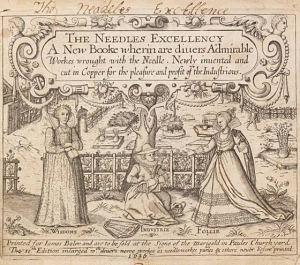
John Taylor’s 1631 poem, In Praise of the Needle, gives us some clues.
Thus is a Needle prov’d an Instrument
Of profit, pleasure, and of ornament;
Which mighty Queenes have grac’d in hand to take,
And high-borne Ladies such esteem did make,
That as their Daughters Daughters up did grow,
The Needles Art, they to their children show.
And as ’twas then an exercise of praise,
So what deserves more honour in these daies,
Then this? which daily doth it selfe expresse,
A mortall enemy to idleness.
The use of Sewing is exceeding old,
As in the sacred Text it is enrold:
Our Parents first in Paradice began,
Which hath descended since from man to man:
The Mothers taught their daughters, Sires their Sons,
Thus in a line successively it runs
For general profit, and for recreation,
From generation unto generation.
Cultural transmission from Paradise, to the Middle Ages, to today. I think we have an obligation not just to transmit the art of sewing, but also the history and tradition. So, I’ll be talking about that here, notwithstanding Taylor’s winking admonition:
And for my Countries quiet, I should like,
That Women-kinde should use no other Pike.
It will increase their peace, enlarge their store,
To use their tongues lesse, and their Needles more.